Overview
Problem
Access to Collegiate Education is Growing, But Regional Inequalities Still Exist
In the Philippines, disadvantaged students are less likely to complete their degrees and are often concentrated in lower-tier institutions (Yee, 2023). This means that increased access to higher education alone is not enough to guarantee equitable learning conditions in the country.
Even with increased budgets for higher education, the quality and equity of education remain uneven across all regions. According to the Philippine Institute for Development Studies (2022), the Philippines still invests significantly less per student than neighboring countries. For instance, the Philippines spends only about 60–72% of Indonesia’s per-student spending despite having a comparable per capita income, which contributes to poor performance in international standardized assessments.
Questions
Does the Commission on Higher Education (CHED) Allocate Its Budget Effectively?
Proper budget allocation significantly shapes both access to and quality of higher education. To ensure that public funds reach regions where they are truly needed, it is necessary to examine how resources translate into educational outcomes. Comparing regions reveals whether spending aligns with student demand, institutional capacity, and equity goals.
To further assess the relationship between funding and higher education outcomes, this study explores two main questions:
- 1. How does regional budget allocation influence education quality, particularly faculty–student ratios?
- 2. Which regions experience higher or lower access to higher education based on enrollment levels, and how do these differences relate to their budgets?
Solution
Using Data Science Techniques to Explore Relationships Between Budget Allocations and Higher Education Outcomes
By using data science techniques, this study analyzes data on regional education budgets, enrollment figures, and faculty-student ratios across higher education institution in the Philippines to determine the relationship between budget allocations and higher education outcomes. This study explores how regional budget allocations affect higher education quality as reflected by faculty-student ratios and accessibility to higher education as reflected by enrollment statistics.
Hypothesis
This Study Proposes the Following Hypotheses Based on The Current Data:
- 1. There is a significant relationship between changes in personnel budget allocation and changes in faculty-student ratios across Philippine regions from 2019 to 2024.
- 2. There is a significant relationship between enrollment growth patterns and personnel budget allocation changes across Philippine regions from 2019 to 2024.
Data
Data Collection
To address the main questions and test the hypotheses, the study utilizaed data obtained from official government datasets and statistical releases from the following sources:
-
1. Commission on Higher Education (CHED)
Regional enrollment data and faculty–student ratios for 2019 and 2024.
-
2. Department of Budget and Management (DBM)
Regional budget allocations for Personnel Services (PS), Maintenance and Other Operating Expenses (MOOE), and Capital Outlay (CO) for 2019 and 2024.
You may access our full Excel dataset through the interactive spreadsheet above, or view it directly through this link .
Methods
Data Preprocessing
To ensure consistency and comparabiltity across datasets, raw data was cleaned and transformed as follows:
Data Standardizing
The obtained raw data contained inconsistencies in formatting, structure, and naming conventions. To prepare the datasets for data visualization, the following steps were conducted:
- Reformatting and standardizing region names and labels
- Converting PDF tables into machine-readable Excel files
- Merging institutional data (2019) into regional summaries
- Aligning 2019 and 2024 datasets to ensure comparability
Feature Engineering
Key performance metrics were created to better capture relational patterns across regions.
- Budget Change By Region (%)
- Enrollment Growth By Region (%)
- Faculty-Student Ratio Change
These variables allowed standardized comparisons between regions regardless of population sizes or budgets.
Results
Summary
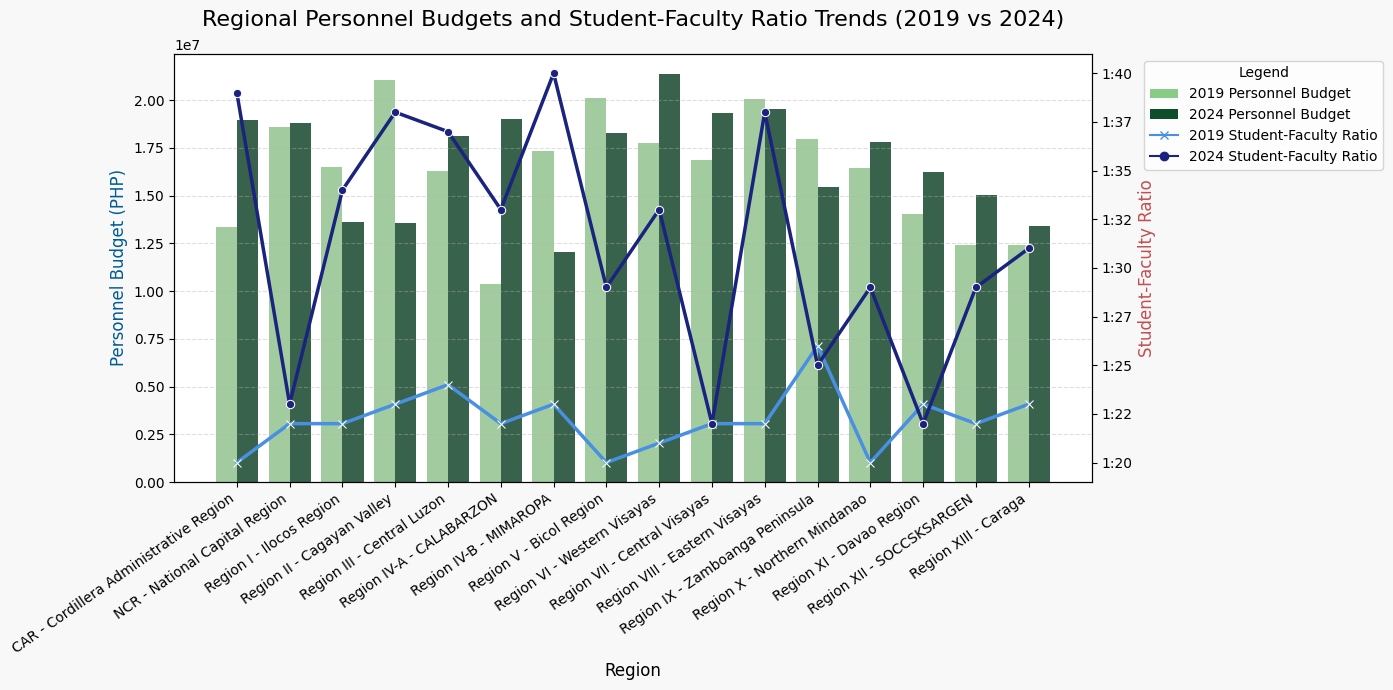
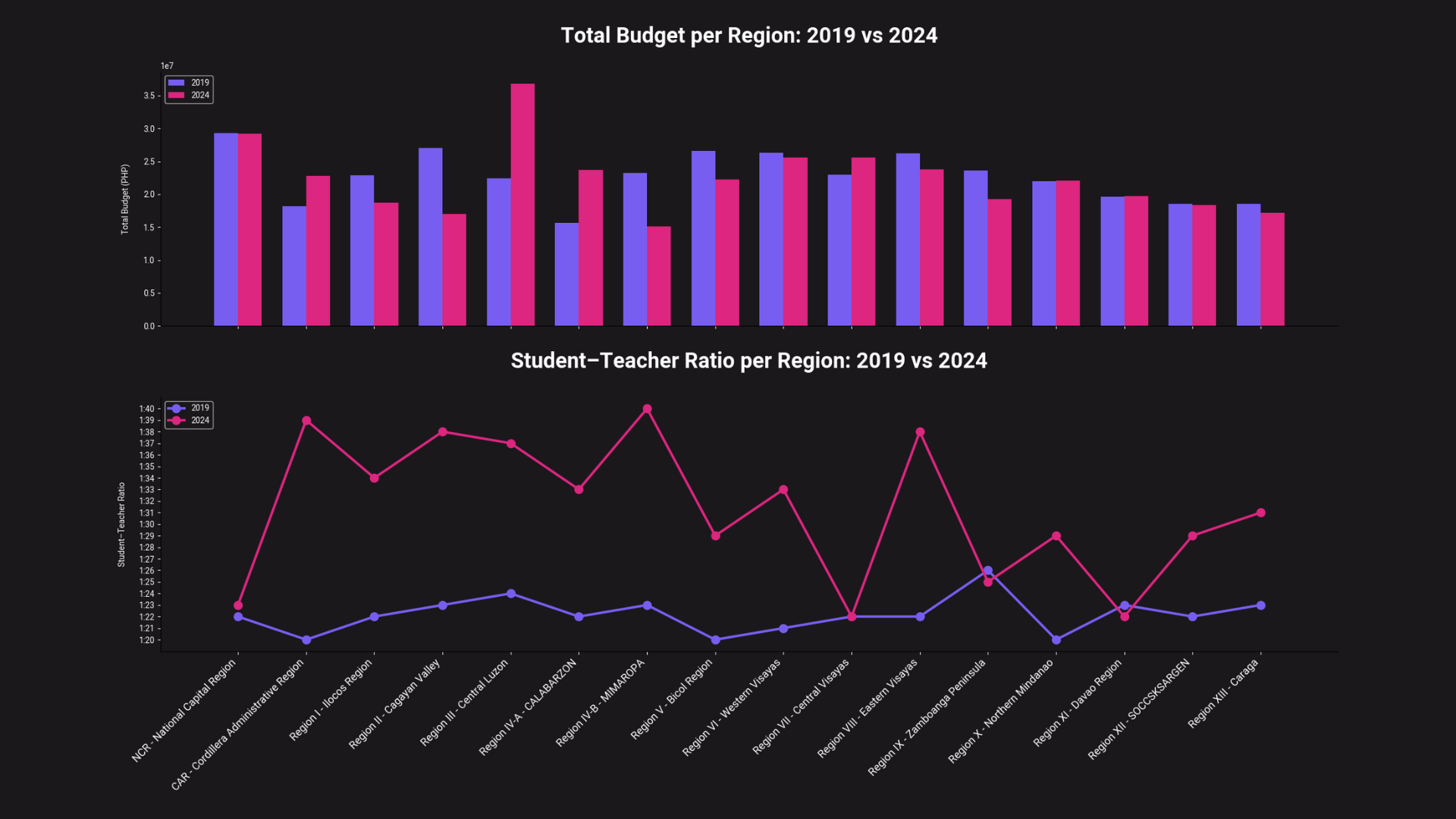
The study shows that higher regional budgets from 2019 to 2024 did not improve the quality or accessibility of higher education in the Philippines. Despite overall budget growth and rising enrollment, faculty–student ratios worsened from 22:1 to 31:1, indicating declining instructional capacity.
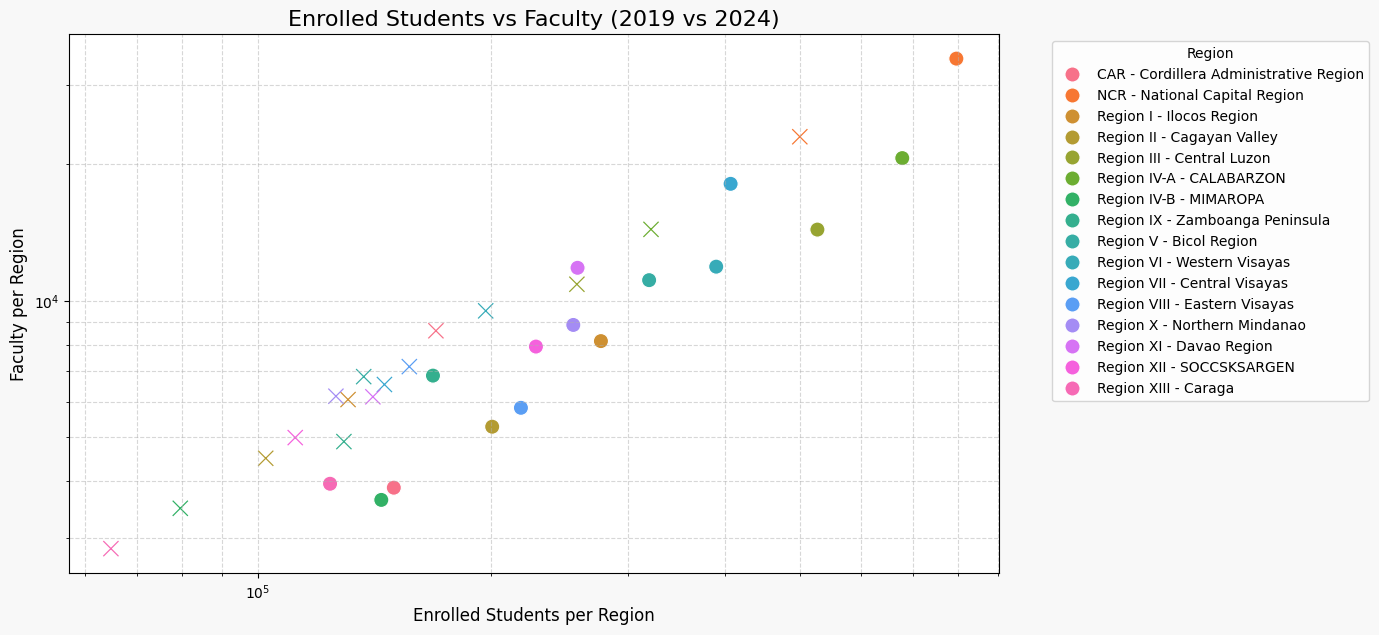
For Research Question 1, both the data visualizations and hypothesis testing show no significant relationship between personnel budget changes and faculty–student ratios (r = –0.156, p = 0.5643). Figures 1.1 and 1.2 illustrate that faculty hiring consistently failed to keep pace with enrollment increases. While regions like NCR and CALABARZON maintained relatively stable ratios, regions such as Eastern Visayas and Zamboanga Peninsula experienced severe mismatches between faculty supply and student demand. This confirms that budget increases have not translated into meaningful improvements in teaching capacity.
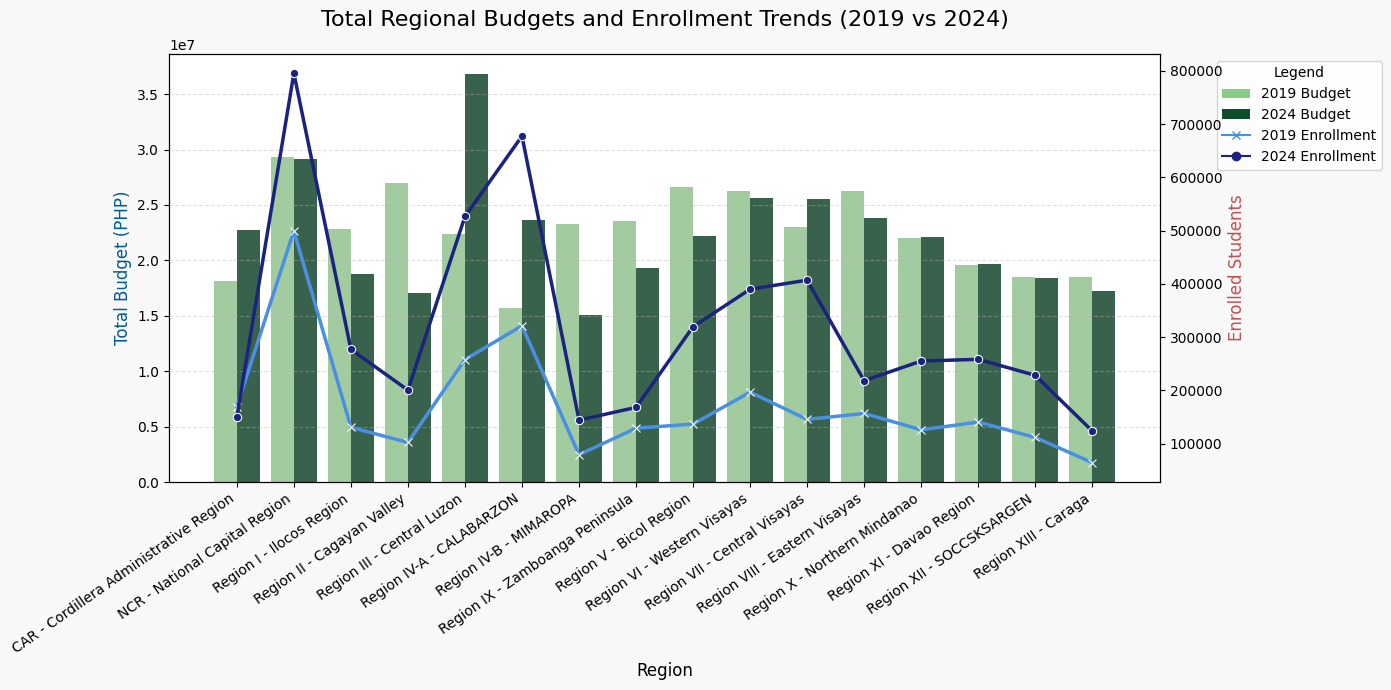
For Research Question 2, the analysis similarly found no significant correlation between budget changes and enrollment growth (r = 0.132, p = 0.6251). Figure 2 shows clear mismatches: regions with the largest enrollment surges—Bicol (133%) and Ilocos (112%)—did not receive proportional budget increases, with some regions even facing budget cuts up to 17%. Meanwhile, regions with stagnant or declining enrollment, such as CAR, received substantial budget gains. This reflects an inequitable funding model that does not respond to actual regional demand.
Overall, the study’s visual trends and statistical tests both point to the same conclusion: budget allocation in Philippine higher education is misaligned with quality needs and enrollment pressures. Funding increases over the five-year period did not improve faculty capacity, and faculty growth continued to lag behind rapid student expansion, resulting in overcrowded classrooms and declining educational quality.
Limitations & Future Research Recommendations
The study contains a few limitations, including the fact that the dataset included both SUCs and private HEIs, but only public institutions are directly affected by CHED/National Government budgets, making comparisons less precise. Although SUC-level data were available, the results were aggregated by region, which limited insights into specific institutions with the largest resource gaps. Additionally, student–faculty ratios and enrollment rates were the only proxies for educational quality used, and broader learning and outcome-based metrics were not included. Lastly, the study’s analysis covered only 2019 and 2024, restricting the evaluation of trends across longer periods.
To address these limitations, we recommend that future studies consider the following ideas. Firstly, there should be a separate analysis of SUCs compared to Private HEIs. Evaluating public and private institutions independently can avoid conflating resource conditions. Additionally, an institution-level evaluation can be done by using SUC-level data to identify specific universities that face the most severe funding or staffing mismatches. An expansion of quality indicators can also help with incorporating outcome-based metrics, such as graduation, licensure, and unemployment data, to measure education quality more effectively. Given the timeline limitations of the current study, analyzing more years can benefit future studies, especially in uncovering long-term patterns in budget shifts, enrollment growth, and faculty capacity. Lastly, placing more focus on the examination of SUC budget allocations and budget expenditures would also be a good point of interest, especially in determining whether resources translate into improved faculty and student support.
Significance of The Study
Education plays a critical role in shaping the future of the Filipino people, making it essential to understand whether current resources truly support quality learning. Hence, this project underscores the importance of data-driven analysis in identifying structural inefficiencies within higher education. By integrating statistical results with visual analyses, the study reveals that current funding mechanisms are reactive rather than proactive, leading to misaligned resources and declining educational quality.
By examining regional patterns in funding, faculty–student ratios, and enrollment growth, the study highlights that sustainable improvement requires aligning budget allocations with measurable indicators of need and performance. The widening mismatch between funding levels, enrollment pressures, and faculty capacity shows that existing allocation practices are no longer adequate to ensure quality, accessibility, and equity across regions. These insights are essential for guiding evidence-based reforms in Philippine higher education.
Call to Action
The results of this study make it clear that higher budgets alone are not improving Philippine higher education. Despite increased funding, faculty–student ratios have worsened, enrollment has outpaced capacity, and resource distribution remains disconnected from actual regional needs.
To reverse this decline, policy decisions must become truly data-driven. Budget allocation should be aligned with measurable indicators such as enrollment growth and faculty shortages rather than applied uniformly nationwide.
Equally important is greater transparency and accountability in how funds are allocated and used. Public institutions must clearly report how personnel budgets impact hiring, instructional capacity, and student outcomes. Without transparent spending and performance monitoring, even increased funding will continue to fall short.
Improving the quality and accessibility of higher education is essential to shaping the future of the Filipino people. This requires smart funding, responsible use of resources, and continuous evaluation. The system must move beyond reactive budgeting and shift toward a proactive, evidence-based approach that ensures every peso contributes to better learning conditions.
Now is the time to commit to fairer allocation, stronger oversight, and a more responsive education system so regional budgets finally translate into meaningful improvements for students nationwide.
Team

Arian Balicusto
rlbalicusto1@up.edu.ph
2023-01223

Dash Ceñido
ddcenido@up.edu.ph
2023-06831

Trish Obzunar
tbobzunar@up.edu.ph
2023-13237

Chloe Santos
cpsantos5@up.edu.ph
ID: 2023-16995
References
- Commission on Higher Education. (2019). 2019 PHEIs faculty-student ratio. https://ched.gov.ph/wp-content/uploads/2019-PHEIs-Faculty-Student-Ratio.pdf
- Commission on Higher Education. (2019). 2019 SUCs faculty-student ratio. https://ched.gov.ph/wp-content/uploads/2019-SUCs-Faculty-Student-Ratio.pdf
- Commission on Higher Education. (2019). CHED regional expenditure program, FY 2019. Department of Budget and Management. https://www.dbm.gov.ph/wp-content/uploads/NEP%202019/OEO/D.pdf
- Commission on Higher Education. (2024). 2024 higher education facts and figures. https://ched.gov.ph/2024-higher-education-facts-and-figures/
- Commission on Higher Education. (2024). CHED regional expenditure program, FY 2024. Department of Budget and Management. https://www.dbm.gov.ph/wp-content/uploads/NEP2024/OEO/E.pdf
- Easdown, N., et al. (2024, June 4). Harmonizing work and higher education: Analysis of the circular flow of income in the Philippine setting. http://dx.doi.org/10.2139/ssrn.4853693
- Philippine Institute for Development Studies. (2022, January 22). PH lags behind regional peers in basic education spending—PIDS study. https://www.pids.gov.ph/details/ph-lags-behind-regional-peers-in-basic-education-spending-pids-study
- Yee, K. M. R. (2023). At all costs: Educational expansion and persistent inequality in the Philippines. Higher Education, 87(6), 1809–1827. https://doi.org/10.1007/s10734-023-01092-y